
An AI strategy your school can actually follow
AI strategy consulting is for school and trust leaders who need a usable order for AI decisions. Dan helps leadership teams examine context, choose priorities, define responsibilities and set safeguards, so they leave with a clearer sequence rather than another abstract briefing.
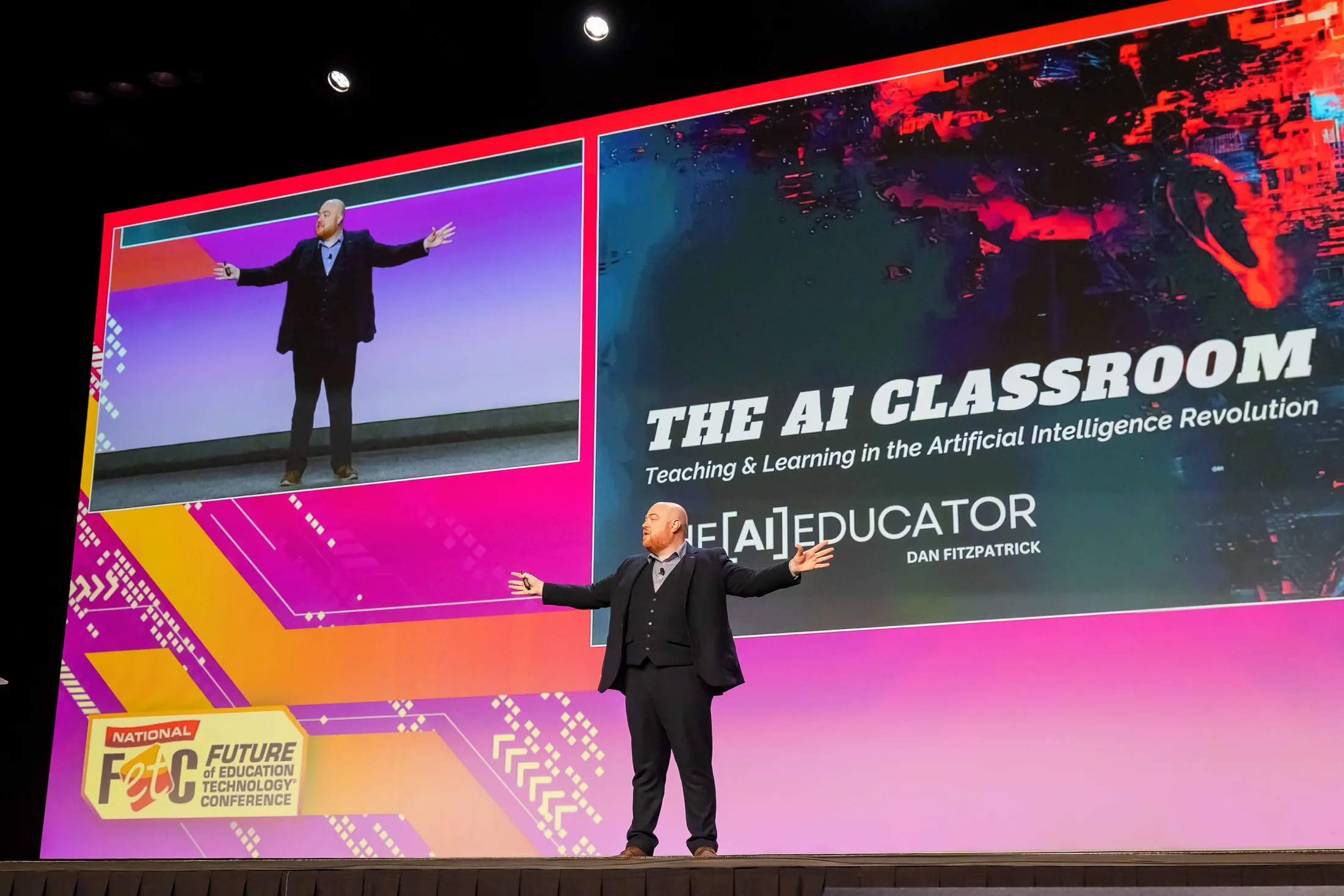
In brief: Dan Fitzpatrick, The AI Educator, is a school AI strategy consultant for schools, multi-academy trusts, districts and international school groups, and can serve as a named Head of AI in Residence. He has trained more than 150,000 educators in over 30 countries and supports leadership teams in the UK, the United States, the Middle East and beyond.
How it works
The Seven Lessons provide a sequence for the work: audit current practice; anchor decisions to real needs; decide what requires action; align recommendations to the school's context; involve the people affected; create conditions for bounded experimentation; and define outcomes that matter to teaching and learning. The sequence is a consulting framework, while statutory duties and official guidance remain the school's reference points.
“Staff concern is useful evidence. Make time to understand it before deciding what responsible adoption should look like.”
Where a school is weighing a modest improvement against a wider rethink, the engagement may also use Dan's Three-Box model to compare improving current practice with reconsidering it. An engagement can include an AI Readiness Report and a written, sequenced plan; the precise outputs should be confirmed when the scope is agreed. Schools and trusts engage Dan as an AI education consultant when they need this sequence facilitated rather than another framework document.
Head of AI in Residence
For schools, trusts and districts that want ongoing leadership rather than a one-off report, Dan can act as your named Head of AI on a rolling engagement of six to twelve months. He takes on a small number of residencies at a time, so each one gets real attention.
Leadership advisory: regular sessions with the headteacher or principal and the senior team to set priorities, make decisions and review progress.
Policy and guardrails review: working with your governance, data protection, safeguarding and IT leads on AI policy, approved tools and boundaries for staff and students.
Staff capability: professional learning for staff and coaching for the people leading AI day to day, so progress does not depend on one enthusiast.
Pilot evaluation: designing bounded pilots with clear questions, then reviewing what the evidence shows before anything scales.
The residency runs on set hours each week, mostly remotely, with optional in-person meetings and events, and progress reviews each month or each term. Scope, outputs and cadence are agreed with you at the start and adjusted as the work develops.
Strategy that fits your governance context
AI strategy has to work inside the rules your school already answers to. Dan shapes each engagement around the guidance and regulators that apply where you are.
| Region | Reference points | What the strategy work covers |
|---|---|---|
| United Kingdom | DfE guidance on generative AI in education; Keeping Children Safe in Education (KCSIE); Ofsted's approach to AI; UK GDPR and ICO guidance; JCQ guidance on AI use in assessments | Acceptable use and AI policy, safeguarding questions, data protection checks for tools, assessment integrity, and readiness for inspection conversations |
| United States | District and school board governance; FERPA and COPPA; state education agency AI guidance; US Department of Education resources | Board-ready strategy, privacy and procurement questions for vendors, alignment with state guidance, and communication with staff and families |
| Middle East and international schools | KHDA (Dubai) and ADEK (Abu Dhabi) requirements and guidance; inspection and accreditation frameworks used by international, British and American curriculum schools | Policy aligned to regulator expectations, multi-curriculum and multilingual contexts, and consistency across groups of schools |
This work helps leaders ask the right questions of these frameworks. It is not legal advice and does not certify compliance; each school remains responsible for its statutory duties.
Selected work with schools and systems
Falkirk Council, Scotland
What Dan did: A keynote for the council's education service.
What they said:
“Dan’s keynote woke us up to the urgency of embracing AI in education and challenged us to grab the opportunity with both hands. He certainly has left a lasting impression on our entire education service.”
GEMS Education, Dubai
What Dan did: Sessions with teachers at GEMS schools in Dubai.
What they said:
“Getting Dan into your school to speak for one hour will transform your teachers’ way of thinking. It will be the best PD you do all year.”
Archdiocese of Louisville Catholic Schools, USA
What Dan did: Professional learning for educators across the archdiocese's schools.
What they said:
“Dan’s balanced view of the use of AI takes tools that could be intimidating and makes them much more approachable and useful for practicing educators.”
Blessed Sacrament School, Albany, New York
What Dan did: Professional development for the school's staff.
What they said:
“This was the first PD that my staff walked away from excited about! We had email and text chains that began immediately as staff discovered new resources. He was excellent!”
Best for
A leadership team that has AI showing up in classrooms already, unplanned, and needs to get ahead of the decision before it gets made for them by default.
Frequently Asked Questions
01Where do we start if we haven't done anything on AI yet?
Start by establishing what is already happening, what problem the school is trying to solve and which existing policies apply. The School AI Readiness Scorecard can support an initial conversation, but it is not an audit, certification or compliance test.
02Does this replace the need for staff training?
No. Strategy sets the direction; Training and Workshops for Schools is how staff build the skill to act on it.
03What do we actually receive?
Possible outputs include an AI Readiness Report and a sequenced plan based on the Seven Lessons framework. Deliverables depend on the agreed engagement and should be confirmed before work begins.
04How does strategy work address safety and governance?
It helps leaders identify ownership, decision points, guardrails and questions for further review. It does not provide legal advice or certify compliance; schools should check applicable law, regulator guidance, safeguarding duties, procurement terms and local policy.
05Should strategy come before pilots or coaching?
Discovery usually comes first. A bounded pilot may provide evidence for strategy, while coaching can support the leader coordinating the work. Wider training is easier to target once leaders have defined the purpose and boundaries.
06What should an AI strategy for schools include?
A workable school AI strategy usually covers five things: an audit of current AI use, priorities anchored to real teaching and learning needs, named ownership of decisions, safeguards and boundaries for experimentation, and outcomes the school will actually review. The Seven Lessons sequence orders these into a plan a governing body can follow.
07Is this the same as hiring an AI education consultant?
Yes, in practice. Dan works as an AI education consultant for schools and trusts, but the engagement is structured around the school's own context and decisions rather than a generic consultancy report. Strategy consulting, staff training and leadership coaching can be combined in one engagement.
08How much does a school AI strategy consultant cost, and how is an engagement scoped?
Dan does not publish fixed prices because no two engagements are the same. The fee depends on the size of the organisation (one school, a trust or a district), the depth of the work (a single strategy session, a readiness review with a written plan, or an ongoing residency), how much is delivered in person and any travel. Scoping starts with a short conversation about where you are and what you need, followed by a written proposal setting out the outputs, timeline and fee before work begins.
09What is a Head of AI in Residence for a school or MAT?
It is a rolling engagement of six to twelve months in which Dan acts as your named Head of AI. He works with your senior team on priorities, policy and guardrails, supports staff capability and helps evaluate pilots, for set hours each week and mostly remotely. It gives a school, trust or district experienced AI leadership without immediately recruiting a permanent, full-time AI lead.
10Do you work with schools outside the UK?
Yes. Dan supports schools, trusts and districts in the UK, the United States, the Middle East and internationally, in person and online, and shapes the work around the guidance, inspection and data protection rules that apply in each region.
Next steps
Start a conversation about what comes next.
Share a few details about you, your organisation or event. Dan personally reviews every enquiry.
Book Now